
A keyword that looks strong in one country can be almost dead in another. "Compare search volume" almost always means comparing a term across markets, because the decision it feeds is a market decision: which country gets a localized landing page, which gets ad budget, and which is too small to justify translation. This page is a method for comparing keyword volume by country without fooling yourself with mismatched settings or a single tool's bias.
The short answer
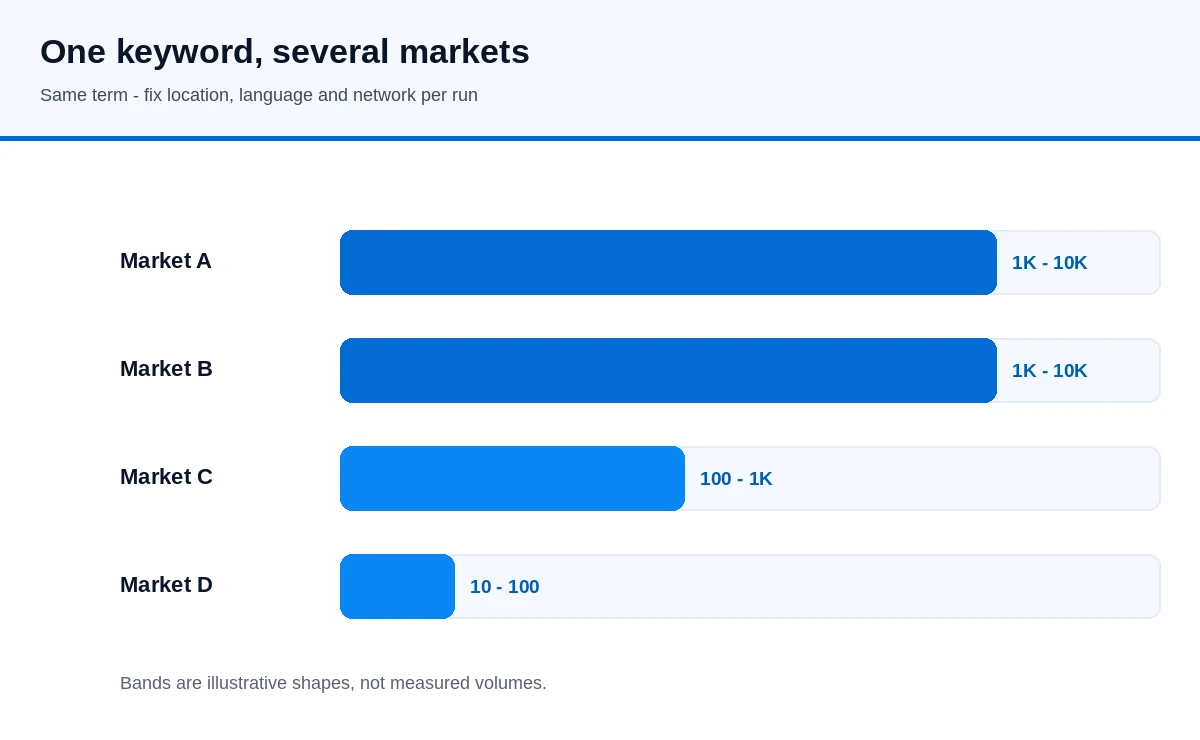
To compare a keyword across countries, re-run the same keyword list once per country with the location, language and search network fixed for that run, then compare the same term's position in the table rather than mixing rows from different runs. Google Keyword Planner is the starting point; Google Trends confirms whether the interest is real and seasonal; and your own Search Console data tells you which countries already send you impressions. No source returns exact counts, so you compare bands and order, not decimals.
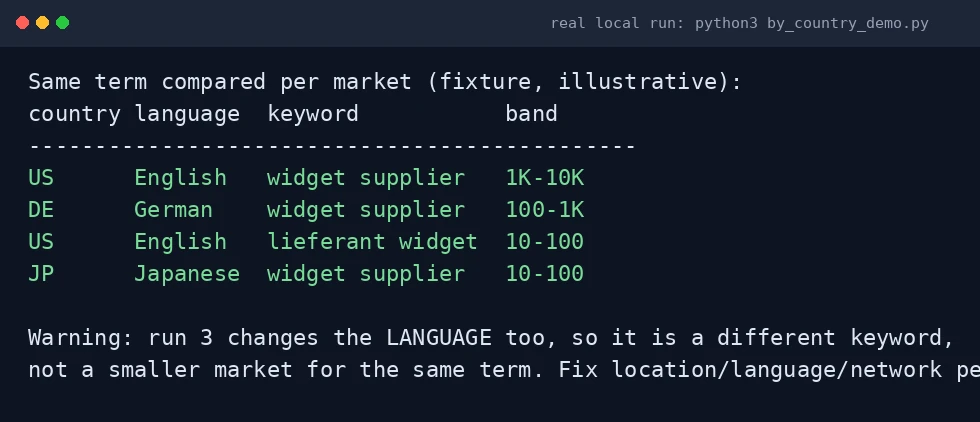
#!/usr/bin/env python3
# Illustrative fixture: comparing ONE keyword across markets requires matched
# location+language+network per run. Numbers are a hand-made example, NOT Google data.
import csv, io
raw = """run,country,language,network,keyword,band
1,US,English,Google Search,widget supplier,1K-10K
2,DE,German,Google Search,widget supplier,100-1K
3,US,English,Google Search,lieferant widget,10-100
4,JP,Japanese,Google Search,widget supplier,10-100
"""
rows=list(csv.DictReader(io.StringIO(raw)))
for r in rows:
    print(r["country"], r["language"], r["keyword"], r["band"])
Why the same keyword differs by country
- Language and usage. The identical English phrase can be common in one market and rare in another where buyers search in a local language or use a different phrasing.
- Setting drift. Keyword Planner volume depends on the location, language and network you selected. If one row was run on "all locations" and another on a single country, the comparison is invalid.
- Close-variant grouping. Google reports volume for a keyword and its close variants. A term that groups with synonyms in one language may not group the same way in another.
- Market size and maturity. Smaller markets have lower absolute demand even when the intent is identical.
A repeatable cross-country method
- Fix one keyword list. Use the same 10–20 candidate terms for every country so the rows line up.
- Run once per country in Keyword Planner. Set location, language and network for that country, and export the country's table before changing settings for the next one.
- Record the band and the date. Note the range, not a single figure, and the date you pulled it, because volumes and forecasts are refreshed over time.
- Confirm with Trends. Put the term into Google Trends with each country selected, and compare the interest curves. Trends shows whether interest is concentrated, seasonal or split between phrasings.
- Overlay your own Search Console data. Filter your property by country to see which markets already send impressions and clicks, and for which queries. Real impressions for your site beat any third-party estimate for priority.
- Decide per market, not globally. A market can justify a page even at lower volume if the intent is commercial and the competition is weak; a high-volume market may not be worth it if the results are owned by strong, perfectly matched pages.
A decision structure (relative, not invented numbers)
| Signal in a country | Trends | Your Search Console | Likely action |
|---|---|---|---|
| Same band as your main market | Stable or rising | Some impressions already | Localized page plus internal links from the main page |
| One band lower, commercial intent | Flat | Few or no impressions yet | Test with one well-targeted page, then measure |
| Two or more bands lower | Declining | None | Usually skip a dedicated page; mention the market on the main page if relevant |
These are relative bands, not measured figures. Replace each cell with what your own tools report for your own market — the structure is the point, not the values.
Pitfalls that distort a cross-country comparison
- Comparing a global figure to a single-country figure. Reset the location for every run.
- Comparing different languages without noticing. A term in English and its translation are two different keywords with two different demand profiles.
- Treating a range as a ranking. Two terms in the same bucket cannot be ordered by volume.
- Ignoring that volume is not opportunity. A big number in a market where the first page already answers the query perfectly is not an opening.
Related reading
- What tools show Google keyword search volume, trends and competition
- Why Keyword Planner shows volume ranges
- How to cross-check keyword search volume when tools disagree
- How to choose the main country to target in Google Ads
Sources
Volume figures are estimates and depend on the location, language and network settings you choose. Verify current behaviour in Google's help documentation; this page does not report invented market volumes.