
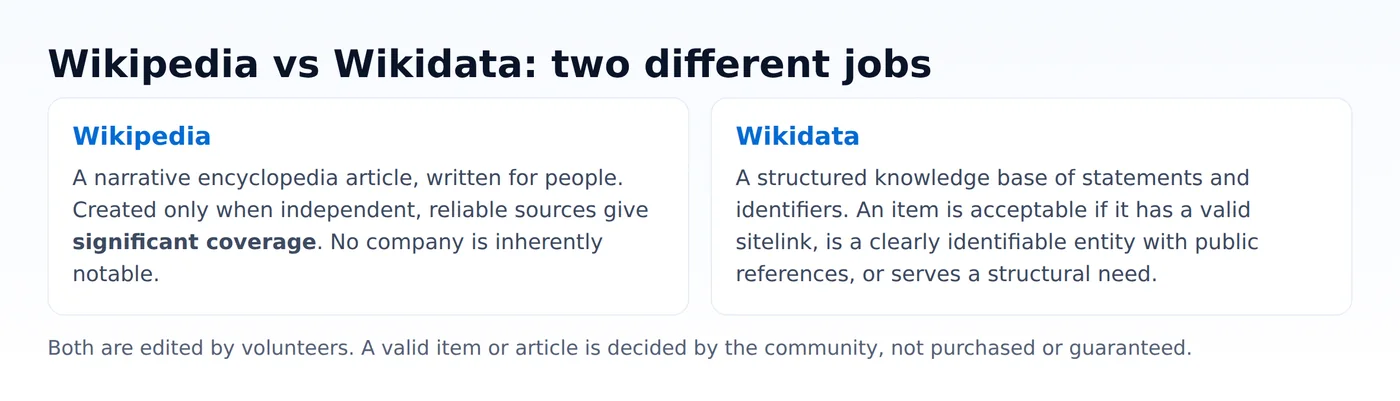
Wikipedia and Wikidata are both Wikimedia projects, and people treat them as two doors into the same room. They are not. Wikipedia holds narrative encyclopedia articles, and a company gets one only when independent, reliable sources have given it significant coverage. Wikidata holds structured statements and identifiers about an entity, under different and often looser rules. If your question is "can my company be added," the honest answer is: you can't add yourself to Wikipedia, you can add properly referenced facts to Wikidata if an item already qualifies, and neither result can be bought or guaranteed.
The one-sentence difference
Wikipedia is prose about a subject for human readers; Wikidata is a database of statements about an entity for machines and other projects. The same company can be discussed in one and described in the other, but passing the bar in one does not grant the other.
Wikipedia: an article about you, written by others
English Wikipedia's guideline for companies is unusually direct. An organisation is generally considered notable if it has been "the subject of significant coverage in reliable, independent secondary sources." It adds that "no company or organization is considered inherently notable," that notability is not inherited (a famous parent company does not make a subsidiary notable), and that self-promotion and paid media do not count — "only unpaid sources count."
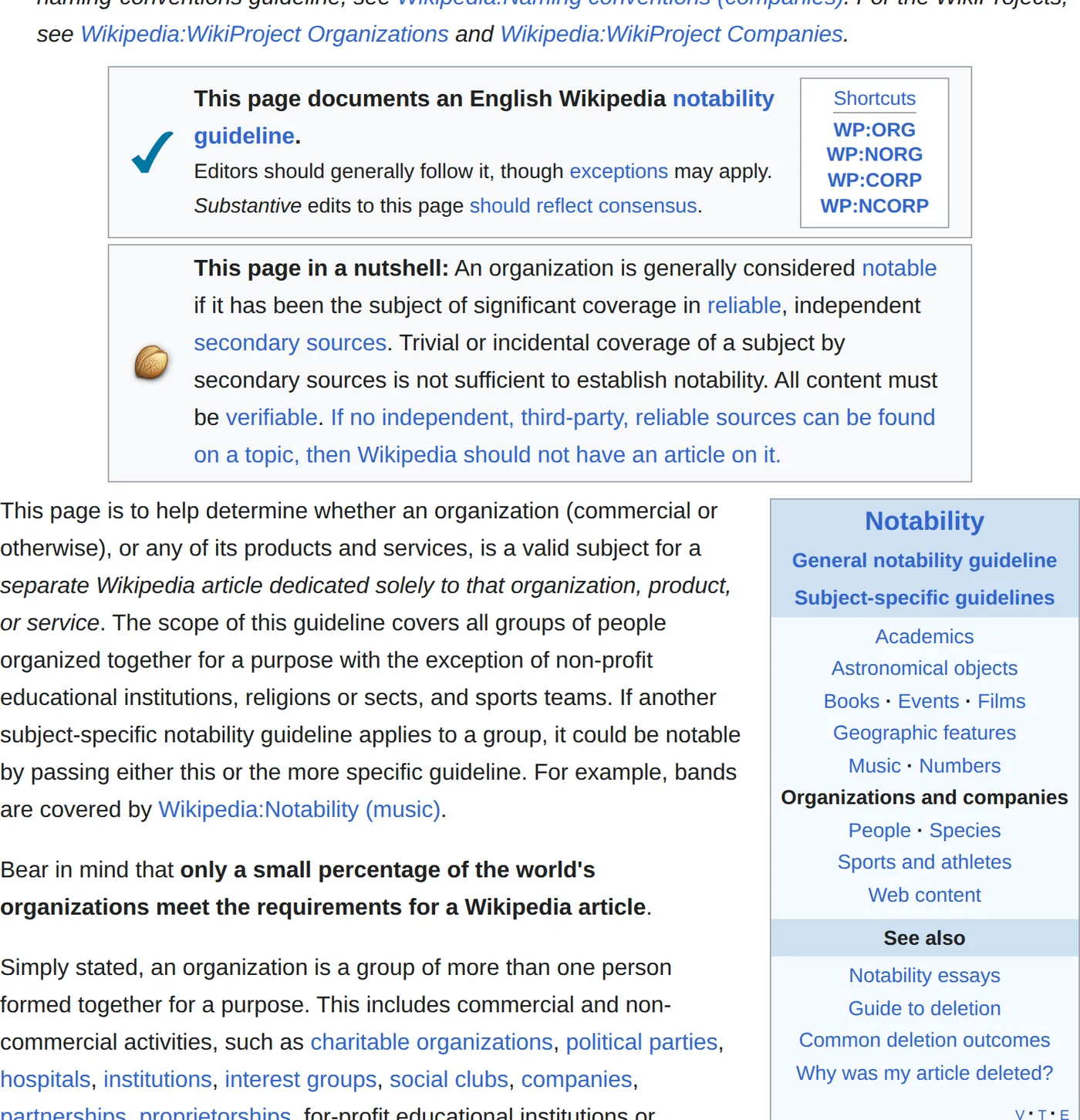
That has a practical consequence: whether an article is possible depends on whether independent journalists, industry analysts or academics have already written about you in depth — not on your revenue or technical strength. Routine coverage (a trade-show stand, a product launch, an award) is explicitly not enough. Wikipedia also notes that "only a small percentage of the world's organizations meet the requirements."
Wikidata: structured facts about an entity
Wikidata's notability policy is a different test. An item is acceptable if it meets at least one of three criteria: it has a valid sitelink to a Wikimedia page; it refers to "a clearly identifiable conceptual or material entity that can be described using serious and publicly available references"; or it serves a structural need for other items. The policy also admits the criteria are "intentionally left a bit vague," with disagreements settled by community discussion.
For a company, Wikidata is closer to a place to attach verifiable facts — official name, website, industry, headquarters, identifiers — with sources, so other systems can read a stable version. It is not a brand billboard, and unsourced or promotional claims are removed. But the entry bar is lower than Wikipedia's, which is why "a Wikidata item exists" should never be mistaken for "the company is notable enough for an encyclopedia article."
What evidence each one asks for
| Wikipedia | Wikidata | |
|---|---|---|
| Unit | A narrative article | An item of statements |
| Core test | Significant coverage in independent, reliable secondary sources | A valid sitelink, a clearly identifiable entity with public references, or a structural need |
| Your own website | Not independent; does not count | Can support some statements, but public references are expected |
| Who decides | Volunteer editors; deletion discussions | Volunteer editors; deletion requests |
| Can it be bought? | No | No |
What a B2B company can realistically do
- Audit your independent coverage first. List every public mention from the last three years and mark three things: is the publisher independent, is the piece about you rather than a passing mention, and is there a named author. Only mentions that pass all three are candidate sources.
- If an article already exists and contains an error, propose a correction on the article's talk page, disclose your connection, and cite a source. English Wikipedia's conflict-of-interest guideline strongly discourages editing affected articles directly.
- If no article exists and no independent sources do either, the useful move is to earn the coverage — publish verifiable, citable work — not to keep resubmitting a draft.
- For Wikidata, check whether an item already exists and whether it qualifies; if it does, add referenced facts rather than marketing copy.
Paid editing and conflict of interest: the rules you cannot skip
If anyone is paid to contribute, Wikimedia's terms require them to disclose their employer, client and affiliation on their user page, a talk page or in an edit summary; editors who fail to disclose are prohibited from editing. This is exactly why any service that promises "we will build your Wikipedia page" is promising something the platform forbids. There is no authorised channel to guarantee an article, and no legitimate way to buy one.
What this means for search and AI answers
Open knowledge bases are one external fact base among many — useful, not a required first step. Their real value is giving basic facts (legal name, founding date, industry, official website) a stable, machine-readable version that other systems can read. Because entities and brands get referenced in AI answers too, a consistent public record helps; but treating Wikidata as a ranking switch, or Wikipedia as a link-building channel, misreads what they are. Our guide to Wikipedia links and SEO covers the referral and nofollow side, and the Chinese guide Wikipedia 与 Wikidata:收录条件、边界与常见失败 covers the failure patterns in more depth for a Chinese-speaking team.