
Comparison content does not have its own AEO ranking factor, and there is no published formula that turns a table into an AI citation. What comparison pages do have is a structural advantage: when two options are measured on the same dimension, in the same unit, under the same condition, with a stated verdict, a system can lift one clean statement without guessing. The honest way to answer "how does comparison content affect AEO rankings" is therefore split in two: the part you control is whether the comparison is extractable and trustworthy; the part you do not control is whether Google or any other answer engine chooses to cite it.
Short answer: structure affects extractability, not a ranking score
Google's own position is explicit. In AI features and your website, it states there are "no additional requirements to appear in AI Overviews or AI Mode, nor other special optimizations necessary," and that no special schema is needed. Its generative AI optimization guide goes further and calls out myths: you do not need a special markup file, you do not need to "chunk" content into fragments, and there is no ideal page length.
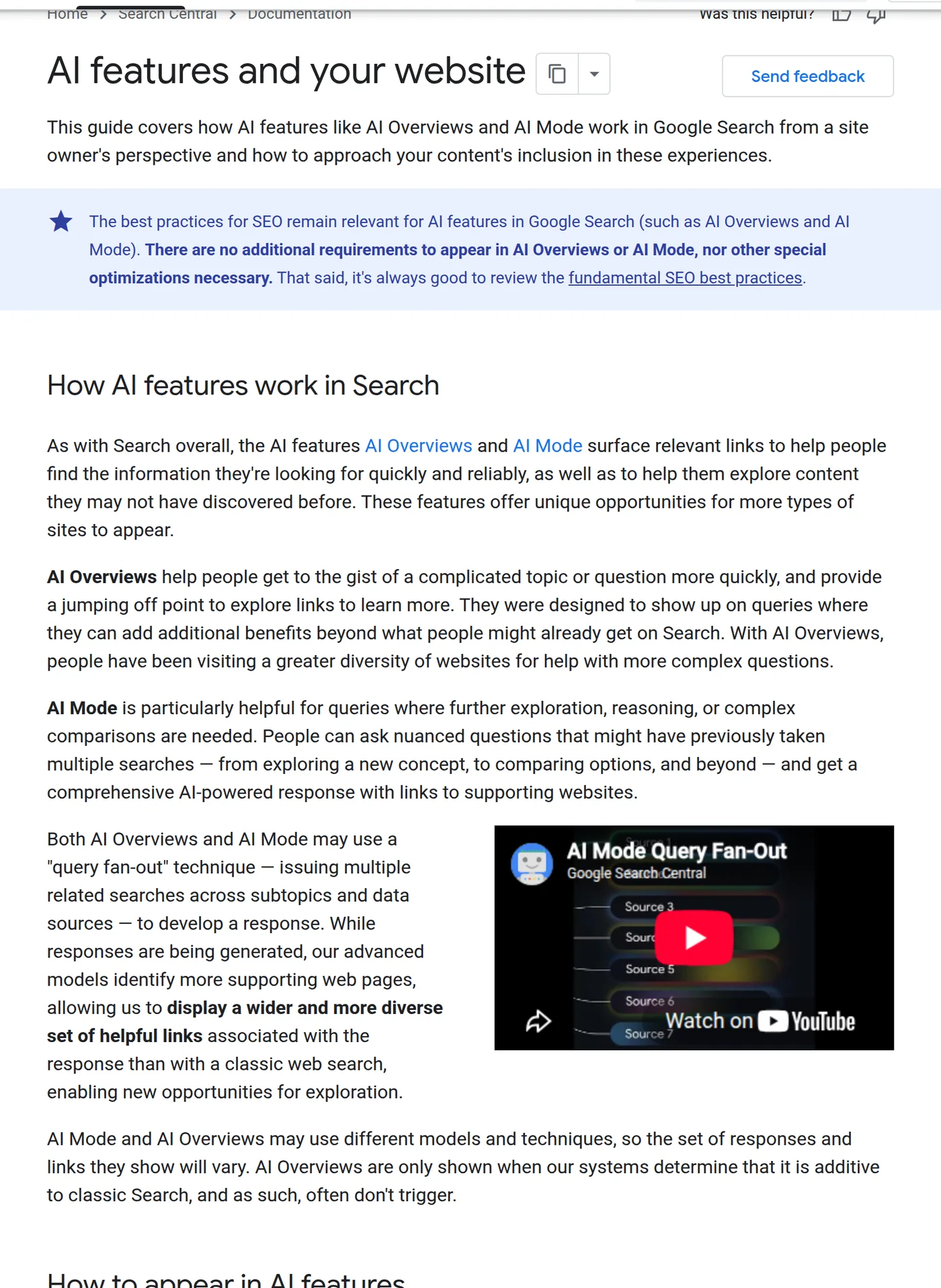
So a comparison page is not "optimized for AEO" in the sense of a switch you flip. It is simply easier to read and easier to reuse — for people and for systems that assemble answers — than a page where the deciding numbers are scattered across prose. That is a real but bounded advantage.
The four rules that make a comparison extractable
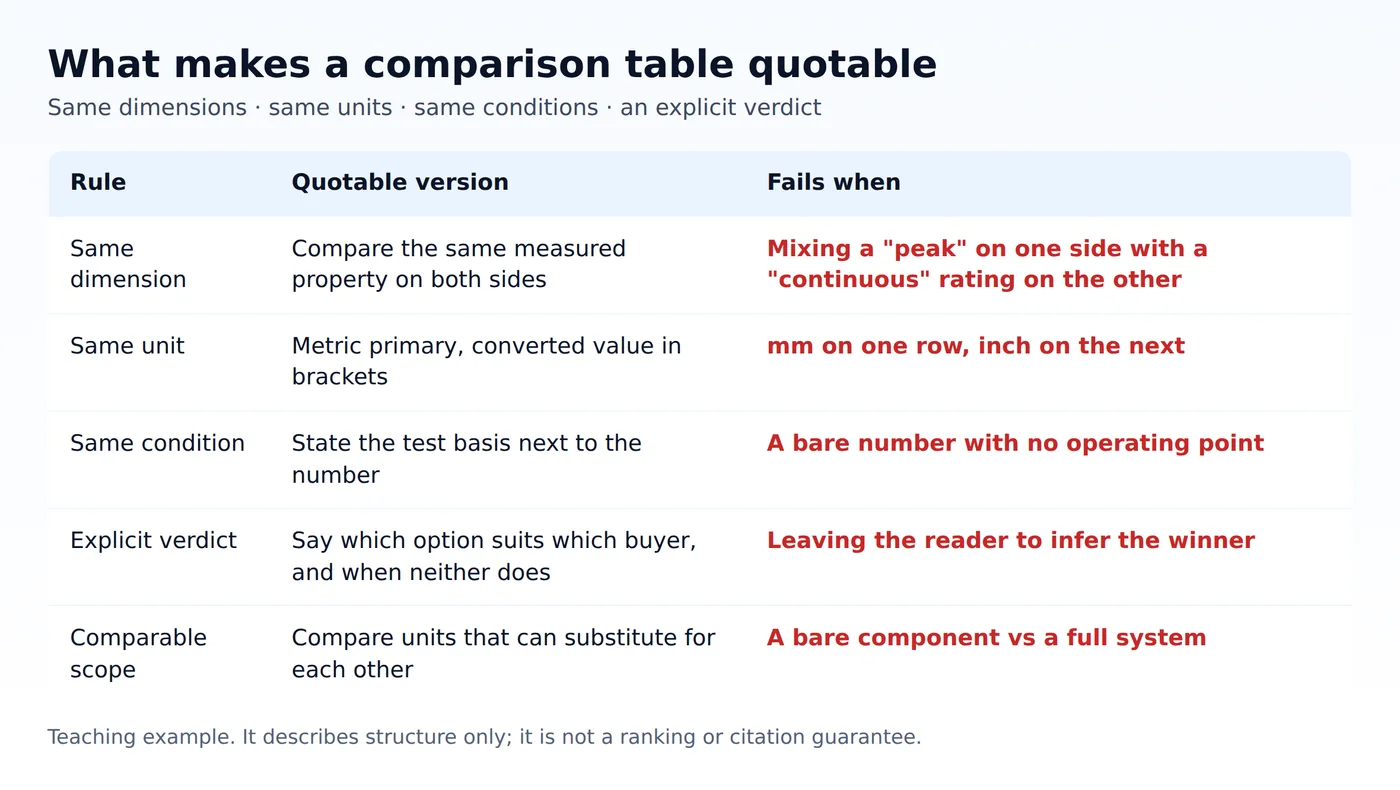
The difference between a comparison that gets reused and one that does not is rarely length. It is whether a single line can be lifted and still be true. Four rules cover most of it.
| Rule | What it means in practice | Fails when |
|---|---|---|
| Same dimension | Both columns measure the same property | A peak rating on one side, a continuous rating on the other |
| Same unit | Metric first, converted value in brackets, one unit per row | Millimetres on one row and inches on the next |
| Same condition | The test or operating point sits next to the number | A bare figure with no basis |
| Explicit verdict | State which option suits which buyer — and when neither does | Leaving the reader to infer the winner |
The missing fifth rule is scope. Two things only belong in the same comparison if a buyer could realistically substitute one for the other. A bare component next to a fully assembled system may share a parameter and still not be comparable.
A worked example (teaching data only)
The table below is invented to show the shape, not to describe any real product. Note how each row answers "under what condition" before it gives a number, and how the last row is a judgment rather than a value.
| Dimension | Option A | Option B | Basis / condition |
|---|---|---|---|
| Rated airflow | 1,200 m³/h | 1,050 m³/h | Rated point, 50 Hz |
| Noise at 1 m | 62 dB(A) | 58 dB(A) | Rated operating point, free field |
| Service interval | 3,000 h | 2,000 h | Manufacturer schedule |
| Best for | High-volume duty | Quiet environments | Editorial judgment from the rows above |
Because the verdict row names a condition ("high-volume duty", "quiet environments") instead of crowning a winner, the table stays true even for a reader whose priorities differ. A comparison that declares one option universally better is the one most likely to be dismissed as a sales page.
What not to compare
- Different scopes. A component versus a turnkey system. The numbers may both exist; the comparison still misleads.
- Numbers without conditions. A life figure with no test basis is not a fact a careful reader can use.
- Your page against your own marketing. A comparison whose only job is to make one option win reads as advertising, not reference.
- Confidential data presented as public. If the numbers cannot be published with a source, do not put them in a public table.
Extractable is not the same as cited
This is the part most "AEO" advice skips. A structure can be perfectly extractable and still never be selected, because the answer engine decides what to surface, and that decision changes per query, language, market and model. Google's documentation repeats that indexing and serving are not guaranteed even when a page meets every stated requirement. So the correct claim is bounded: a clean comparison is easier to use; being used is not yours to command.
That also means you should not chase invented metrics. There is no "AEO score" you can raise by adding a table, and no way to buy a citation. The measurable things are mundane: is the table readable on a phone, does each number have a basis, is the date of the data current, and does the page say who is making the comparison.
How this fits with our other comparison guides
This article is the English counterpart to three Chinese guides we keep deliberately separate. 对比和选型页为什么容易被引用 explains why comparison and selection pages get referenced in the first place; 参数对比表怎么做:同维度、同单位、同条件 is the mechanics of a single table; and 竞品对比页怎么写才经得起核对 covers wording and evidence when a competitor is one of the columns. If you write in English for an international audience, this page is the one to start from, and the same four rules apply.
A checklist before you publish
- Does each row compare the same property, in the same unit, under the same condition?
- Can a reader lift one line and still be correct?
- Is there an explicit verdict that names who each option suits?
- Is every number traceable to a dated source or a labelled teaching example?
- Would a phone reader see the rows in a sensible order?
- Have you avoided implying that the table earns citations?
If the comparison genuinely helps a buyer decide, it is doing the work that makes reuse possible. If it only decorates a product page, no structural trick will fix that. When you want the full chain — research, comparison content, technical SEO and links — see the Guangsuan GEO service or start from the Google SEO service.