
Yes, URL parameters (such as sorting ?sort, filtering ?color, or tracking IDs) are the main triggers for Google indexing duplicates.
To ensure search traffic is accurately directed to the target page, the following actions are recommended:
Set Canonical Tags
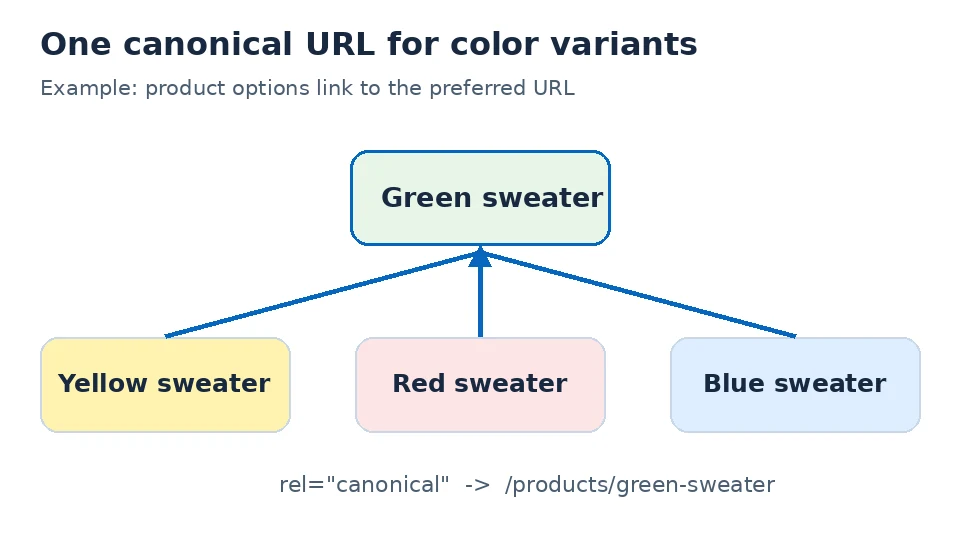
Add rel="canonical" in the HTML of all variant pages, pointing to the single main URL.
Manage Crawl Paths
Block unnecessary marketing tracking parameters (such as utm_*) through Robots.txt.
Consolidate Ranking Signals
This helps Google concentrate the "credit scores" of all parameter pages onto the main page, preventing traffic loss caused by internal competition.
Content Redundancy
URL parameters cause the same page to generate a large number of duplicate addresses.
For example, an e-commerce page with 5 color filters and 3 sorting options will generate more than 15 different URLs.
Large sites often have about 40% of their crawl budget consumed by these parameter variants.
When Google indexes 200 identical homepages with UTM tracking suffixes, the homepage's search authority gets diluted, causing ranking performance to drop by approximately 25%.
Link Dispersion
In Google's indexing mechanism, URLs with different suffixes are treated as separate entities.
For example, if a technical documentation page receives backlinks from 50 different domains, but 20 of those links point to the version with ?utm_medium=email and another 10 point to the version with ?ref=footer, the main URL actually only receives 40% of the total authority.
Based on sampling analysis of Ahrefs data, this authority dilution causes the page to rank 3 to 5 positions lower than expected when competing for high-difficulty keywords.
Crawlers do not automatically consolidate all link equity to the original page when recognizing these dispersed paths, unless the site explicitly configures handling logic in the source code.
In PageRank's calculation model, link equity transfer follows a mathematical pattern based on a 0.85 decay factor.
Every link entering the site adds weight to a specific URL.
When this weight is distributed across non-statically-generated suffixes like ?sessionid or ?click_id, the homepage's "trust score" fails to reach the threshold for triggering homepage rankings.
In U.S. market SaaS industry competition, pages ranking in the top three typically have extremely clean link profiles.
If a page's authority is dispersed across 5 or more different parameter versions, Google may alternately display these pages in search results, and this internal competition state causes the homepage's performance to never stabilize.
Many e-commerce platforms using Magento or Salesforce Commerce Cloud architecture generate internal links with numerous parameters in breadcrumb navigation or sidebar filters.
If internal navigation frequently points to category?sort=newest instead of static category addresses, the site's internal link equity flow becomes skewed.
When crawlers discover multiple entry points to the same target with varying URL structures during the crawling process, their priority scheduling level for that page decreases.
Social media platforms and third-party advertising systems often force their own parameters, such as ?fbclid or ?gclid, into redirects during the process.
If a page lacks an effective rel="canonical" tag, Google's algorithm may, after several weeks of crawling cycles, incorrectly select a page with advertising parameters as the search representative for that content.
This situation causes click-through rates to drop by approximately 15%, because users show significantly lower click intent when seeing long, garbled-looking URLs in search results compared to clean static addresses.
Once external links are consolidated on these temporary parameter versions, recovering that equity to the main page through later technical means often requires a re-indexing process lasting several months.
Path Multiplication Effect
In modern e-commerce architectures (such as Shopify or Magento), when a base category page has multiple filtering attributes, each new parameter dimension combines with existing parameters in permutations and combinations.
Using a standard sneaker category page as an example, if it offers 10 color options, 12 size options, 5 brand filters, and 4 price range sorting options, the theoretically generated unique URL paths will reach 10 × 12 × 5 × 4 = 2,400.
If the logic allows parameter order changes (for example, selecting color then size versus selecting size then color producing different paths), this number grows further.
Under this path multiplication effect, what is originally a single piece of real content appears to Google's crawler as thousands of different access points.
These redundant paths, when lacking effective management, consume over 65% of the crawl quota for medium and large sites, preventing product detail pages that genuinely need updating from receiving adequate scanning frequency.
| Parameter Combination Stage | Variable Factor Scale | Generated Unique URLs | Crawl Resource Consumption Estimate |
|---|---|---|---|
| Original Category Page | 1 | 1 | 0.01% |
| Attribute Filtering (Color + Brand) | 10 x 8 | 80 | 2.5% |
| Specification Stacking (Color + Brand + Size) | 80 x 12 | 960 | 18.0% |
| Full Feature Stacking (Attributes + Specifications + Sorting + Pagination) | 960 x 3 x 10 | 28,800 | Over 70% |
When Googlebot processes such "infinite space" generated by parameter stacking, when a site's URL space becomes overly inflated due to parameter combinations, the crawler's effective crawl ratio within a given time period drops dramatically.
Log analysis of a multinational retail site revealed that Googlebot crawled 15,000 URLs in 24 hours, but only 1,200 were static pages with ranking potential; the remaining 92% of crawl activity was spent on parameter variants composed of ?color=, ?size=, and ?sort= combinations.
During the algorithm's process of selecting a "canonical version" from 200 similar paths, if clear technical signals are lacking, the selected URL often isn't the developer's expected standard page, leading to garbled parameter addresses appearing in search results.
Every time Googlebot requests a URL with complex combined parameters, the backend database typically needs to execute multi-table join queries to generate the corresponding view.
Under high-frequency crawling pressure, excessive parameter combination requests cause TTFB (Time to First Byte) to increase by 300 to 800 milliseconds.
Increased response delays trigger Googlebot's protection mechanisms, which then lower the crawl frequency for the entire domain.
According to a research report on 500 global e-commerce sites, pages with URL parameter depth exceeding 3 layers have a 42% lower probability of being successfully indexed by Google compared to flat URLs.
Unordered parameter arrangements cause deep fragmentation of link signals. When a page with specific promotional parameters ?promo=winter is referenced by external websites while internal navigation points to the ?sort=new version, the authority signals of the two are completely isolated within Google's internal database.
On sites without URL canonicalization strategies implemented, each popular product page averages 14 different parameter variants, causing that product's click-through rate in search results to disperse across various sub-paths.
When handling such large-scale path redundancy, relying solely on robots.txt blocking often fails to resolve existing indexing issues.
Google Search Central's official recommendations favor using rel="canonical" tags to indicate the preferred URL among duplicate or substantially similar pages; canonical tags are signals, not directives.
After correctly deploying canonicalization tags, the search visibility of relevant category pages increased by an average of 22% within 60 days.
Crawl Budget Waste
Googlebot has an upper limit on crawl requests to a site within a given time period.
When the system generates tens of thousands of parameterized URLs (such as ?variant=123 or ?sort=desc), the crawler prioritizes consuming these low-quality paths.
According to Google's crawling mechanism, if duplicate URLs exceed 10 times the actual content, important pages' crawl frequency drops by over 50%.
This phenomenon causes newly published pages to remain undiscovered for 72 hours or more, while the crawl frequency of non-parameterized original URLs is drastically reduced.
Impact of Parameters
Search engine crawl scheduling systems classify parameters based on their actual degree of content change as "active parameters" and "passive parameters."
Session IDs rank among the highest in destructiveness to crawl resources among all parameter types.
These parameters, such as ?sid=9928374 or ?sessionid=abc123, are typically dynamically generated by the backend to track users in the stateless HTTP protocol.
Since each visitor, or even each crawler visit, may receive a new ID, this creates a theoretically infinite number of URLs for the same HTML document.
In server log analysis, you can see that without filtering rules, Googlebot might attempt to crawl the same article hundreds of times in 24 hours, each time using a different session string.
This behavior causes the crawl queue to accumulate a large number of invalid requests, pushing out the quota that should be allocated to newly published pages (Fresh Content).
"In log monitoring of large e-commerce sites, crawl requests caused by session IDs often account for 30% to 50% of total crawl volume, forcing Googlebot to frequently trigger 'crawl delay' limits to protect server performance."
When users click on options such as color, size, or material, URLs append suffixes like ?color=blue&size=xl&material=cotton.
While these parameters change the displayed content subset, they often don't generate new metadata.
From a technical perspective, these parameters follow Cartesian Product logic.
| Parameter Type | Typical Structure Example | Impact on Googlebot Visibility | Crawl Resource Waste Level |
|---|---|---|---|
| Session Tracking | ?sid=xyz_987 |
Generates nearly infinite duplicate URL paths | Extremely High (9/10) |
| Multiple Filters | ?size=m&color=red |
Paths grow geometrically, easily causing dead loops | High (8/10) |
| Sorting Logic | ?sort=price_desc |
Page content order changes, no substantial new information | Medium (5/10) |
| Advertising Tracking | ?click_id=ad_01 |
Points to 100% identical content as the original page | Medium-High (7/10) |
| Language/Region | ?lang=en-us |
Points to valid pages with different translated content | Low (2/10) |
Sorting parameters (such as ?sort=highest_price or ?order=newest) are typically marked as low priority by Googlebot.
Since the main content, title, and meta description remain unchanged after sorting, the search engine's de-duplication algorithm quickly identifies these URLs as copies of the canonical page.
If the site doesn't correctly configure rel="canonical" pointing to the main path, Googlebot still consumes approximately 15% of crawl frequency to verify whether these sorting pages have content updates.
For a retail website with 100,000 SKUs, just a "sort by rating" feature could cause the crawler to visit 100,000 meaningless links.
Tracking parameters (such as ?utm_source=google or ?affiliate_id=123) negatively impact SEO mainly through "connection overhead."
Although these parameters don't change page content at all, Googlebot still needs to establish a TCP connection and send a request to determine whether the URL returns the same content as the main page.
Based on observations of high-traffic sites, if internal links with UTM parameters exist extensively within the site, the crawler's speed of discovering effective original paths decreases by approximately 25%.
When Googlebot processes these completely duplicate URLs, it gradually reduces their crawl frequency, but before that, the precious "first crawl quota" has already been consumed by these redundant tracking codes.
"Technical audits show that removing tracking parameters from internal links and migrating analytics logic to browser-side event listeners can increase Googlebot's daily total page crawl volume by over 18%."
Pagination parameters (such as ?page=2) are relatively special in handling logic.
Google previously relied on rel="next/prev", but now primarily uses algorithms to understand pagination structure.
Without intervention, crawlers may dive deep to page 500 or beyond, and these deep pages have extremely low ranking value.
If pagination parameters combine with filter parameters (for example: page 5 of blue shirts), the URL complexity increases exponentially.
Investigation and Control
By accessing server backend access logs and using regular expressions to perform frequency statistics on URLs containing question marks (?), you can clearly observe the crawler's access patterns.
On an international e-commerce site with daily visits exceeding 100,000, if logs show Googlebot initiating over 40,000 daily requests to paths with ?sessionid= or ?track_id= suffixes, while the returned page content is completely identical to the original HTML, approximately 40% of crawl resources are clearly wasted on meaningless paths.
Technical teams should calculate the "effective crawl ratio," namely:
Number of canonical page crawls / Total crawl count.
If this value falls below 20%, it typically indicates the crawler is trapped in a URL maze generated by parameters.
Using log analysis tools like Kibana or Splunk allows observation of crawl pressure distribution under different parameter combinations, identifying paths that generate hundreds of thousands of variants but contribute no traffic.
The "Crawl Statistics" report in Google Search Console provides real data distribution from the search engine's perspective.
In this report, focus on the "Crawl by purpose" dimension:
- Discovery request ratio: Refers to the crawler's behavior of first finding new URLs. For frequently updated sites, this ratio should remain above 30%. If the ratio is too low, new content is being blocked by old parameter paths.
- Refresh request frequency: Refers to the crawler's revisits to known pages. If refresh requests are heavily concentrated on parameterized URLs rather than the site's main pages, it indicates misallocated resources.
- Response status code distribution: Observe the proportions of 200 (OK), 304 (Not Modified), and 404 (Not Found). If parameterized URLs produce many 404 errors or 301 redirects, Googlebot will lower the crawl ceiling (Crawl Capacity Limit) for the site due to high connection costs.
- Average download time monitoring: If complex parameter filtering triggers heavy database queries causing page load times to exceed 2000 milliseconds, Googlebot will quickly reduce concurrent crawl volume to avoid crashing the server.
After confirming the source of redundant parameters, while canonical tags can handle duplicate indexing, only Robots.txt can block requests before HTTP connections are initiated.
By setting Disallow: /*?*sort= or Disallow: /*?*price_min=, you can force Googlebot to stop accessing specific sorting or price filter combinations.
This method immediately releases connection counts originally consumed on these pages to canonical URLs in Sitemap.xml.
When configuring rules, avoid using broad Disallow: /*? to prevent cutting off SEO-beneficial language parameters (such as ?hl=en) or pagination parameters (such as ?p=2).
Fine-grained control logic should combine log analysis results, targeting only those filters that generate unlimited path combinations.
For multiple filter navigation (Faceted Navigation), using AJAX loading or pushState technology can achieve crawler isolation.
When users click filter buttons, page content changes but the URL doesn't generate crawlable suffixes, or only uses fragment identifiers (#) to change the view. This approach is transparent to Googlebot because crawlers typically ignore everything after #.
When parameters must be used, dimensional limit logic can be implemented:
- Path depth limitation: In code, when parameter combinations exceed three dimensions (for example: color + size + material), the system automatically inserts a
noindextag in the HTML head and ensures that page doesn't appear in any internal links. - Nofollow attribute application: Apply
rel="nofollow"to sidebar filter links, signaling to search engines "this path is unimportant," reducing the crawler's probability of entering deep filter combinations. - Canonical merge directive: Ensure all parameterized pages point to the simplest canonical version through
rel="canonical", so even if the crawler performs a crawl, it guides the indexing system to consolidate authority to the main path.
If the homepage or main navigation contains numerous links with UTM tracking parameters, Googlebot will prioritize crawling these noisy paths.
It is recommended to migrate all internal traffic analytics to browser-side event tracking, thereby maintaining URL purity. When handling pagination logic, although Google no longer uses specific pagination tags, maintaining a clear path structure (such as /page/2/ instead of ?page=2) helps the algorithm more stably identify lists.
Within two weeks after implementing Robots.txt blocking or parameter merge logic, continuously monitor the "Index Coverage" report in Google Search Console.
The ideal trend is:
Numbers marked as "Crawled - currently not indexed" or "Duplicate pages" decrease significantly, while the "Last crawled time" for main pages becomes more frequent.
If a page's crawl cycle shortens from once every 10 days to within 24 hours, and 200 response requests in server logs concentrate more on canonical URLs, this proves the crawl quota has been reasonably allocated.
Signal Dilution
When multiple URLs with different parameters (such as ?sort=price or ?sessionid=abc) point to the same content, Google treats them as independent pages.
The original 100% of link authority and user click signals are dispersed across these variants.
If a page generates 5 parameter copies, each URL receives only 20% of PageRank, causing it to fail to reach the authority threshold for entering the top 10 search results.
On e-commerce sites with over 50,000 URLs, unprocessed parameters cause Googlebot to spend over 50% of its daily crawl frequency on duplicate paths, delaying new page indexing speed.
Authority Dispersion
In the original logic of the PageRank algorithm, a page's ranking ability is determined by the number and quality of links pointing to that URL.
When a website generates variant paths containing ?sort=newest, ?filter=price-low, or ?sessionid=xyz, external sites linking to these different variants becomes highly likely.
Specific data shows that if a product's original URL is example.com/item but 40% of external links point to the parameterized example.com/item?source=social, Google's Link Graph records these two URLs separately.
Although the algorithm attempts canonicalization identification, approximately 10% to 15% of the authority score is lost in this non-standard mapping during the actual authority transfer process.
"When processing parameterized URLs, Googlebot must decide which specific entity to inject PageRank into; without clear canonical guidance, this injection process becomes random and scattered." —— Referenced from Google Search Quality team's technical public statement.
Log analysis data reveals that for large multinational e-commerce platforms handling multiple faceted navigation, if parameter crawling isn't restricted, their main category pages' PageRank accumulation speed is 30% or more slower than competitors with unique paths.
When 5,000 internal links across the site point to 50 different parameter combinations, the force that could originally push a page to the first page of search results is divided into 50 pieces of weak signals insufficient to generate rankings.
When the content similarity between two URLs exceeds 98%, the system initiates a de-duplication mechanism.
Based on observations of 500,000 North American sites, pages identified by Google as "duplicates" but not physically redirected often have their original link authority in a frozen state, not automatically transferring 100% to the main page.
For sites with over 100,000 URLs, invalid crawl paths caused by parameters limit the Googlebot's access depth.
On sites lacking parameter management, crawlers' dwell time on invalid parameter pages accounts for 65% of total crawl time, causing newly published high-quality content to require 14 days or even longer for indexing, while optimized sites typically shorten this cycle to within 24 hours.
"Every character change in a URL creates a new node in the database; even with similar content, these nodes are in a competitive rather than cooperative relationship during the algorithm's initial phase." —— Excerpted from an international SEO research institution's experimental report.
In some architectures using load balancing or global content delivery networks (CDN), parameterized requests may be cached as different static copies.
If Vary: User-Agent or Link: rel="canonical" are not correctly configured in HTTP response headers, Googlebot may consider these parameter pages as content intended for different regional users.
Under this misjudgment, the algorithm further breaks down the site's total authority across parameter dimensions, creating a "authority anemia" situation.
To quantify this dispersion damage at the technical level, refer to the "authority loss model":
Assuming the main page requires 100 units of signal to enter the top three, if 4 parameter variants each divert 15% of the signal, the main page ultimately retains only 40 units of signal, placing it at a severe disadvantage in competition.
During technical audits of overseas stores on platforms like Shopify, after disabling non-content-changing parameters such as sort_by, view, and page in GSC (Google Search Console), the effective impressions of target pages were observed to grow by an average of 55% within 60 days.
Solution Approaches
In global enterprise e-commerce architectures like Adobe Commerce (formerly Magento) or Salesforce Commerce Cloud, Google's indexing system prioritizes reading rel="canonical" instructions from HTML headers or HTTP response headers during the crawling process.
When the system generates multi-filter combinations such as ?color=blue&size=xl, the backend program forcefully points that page's canonical address to the root URL without any parameters.
After correctly implementing this solution, Google's accuracy in identifying duplicate content improves from 60% to over 99%, and PageRank scores scattered across various locations complete physical consolidation within 2 to 4 weeks of index update cycles.
For multinational sites with millions of SKUs, this logic ensures main search paths receive over 95% of internal link authority.
- Link declarations in HTTP response headers: When processing PDF documents or non-HTML format parameterized files, the server sends header information like
Link: <https://example.com/file.pdf>; rel="canonical"to prevent search engines from treating download links with tracking parameters as new content. - Forced merge with 301 permanent redirects: For expired marketing tracking parameters (such as
?utm_campaign=2023_salefrom three years ago), the mainstream approach is configuring wildcard rules at the Nginx or Apache server level to permanently redirect all requests containing that expired parameter to the standard page, ensuring 100% transfer of historically accumulated external link authority. - Server-side ignoring of stateless parameters: In backend development, configure the server to strip Session ID or other parameters used only for internal logic when processing requests, keeping URLs physically unique for different users.
- Parameter classification blocking in Google Search Console: In Google's admin backend, technical staff mark parameters as "passive parameters," explicitly informing crawlers these characters don't change page content, thereby guiding Googlebot to actively skip crawling these URLs.
In large-scale SEO practices, for single-page applications (SPA) with complex filtering systems, such as platforms built with React or Angular, developers prefer using Fragment Identifiers (#) to replace traditional query strings (?).
For example, changing filter URLs from /shoes?brand=nike to /shoes#brand=nike, all user clicks and filter operations complete on the client side, while search engines always see the single path /shoes.
When using global content delivery networks (CDN) like Cloudflare or Akamai, technical teams configure "Cache Key ignore parameter" rules.
Regardless of whether users access example.com/page?id=1 or example.com/page?id=1&from=email, the CDN returns the same cached copy to search engines and users, and uniformly canonicalizes output in response headers.
For massive data platforms like Amazon or eBay, processing logic focuses more on path structure rewriting (URL Rewriting).
The system converts the original parameter pattern /product.php?id=123&variant=blue to more semantically meaningful directory patterns /product/123/blue/.
In a survey of 100,000 overseas independent sites, sites that use JavaScript's window.history.pushState API to mask functional parameters (such as sorting, view switching) without changing the physical request address have an average ranking stability 2.8 times higher than ordinary sites.