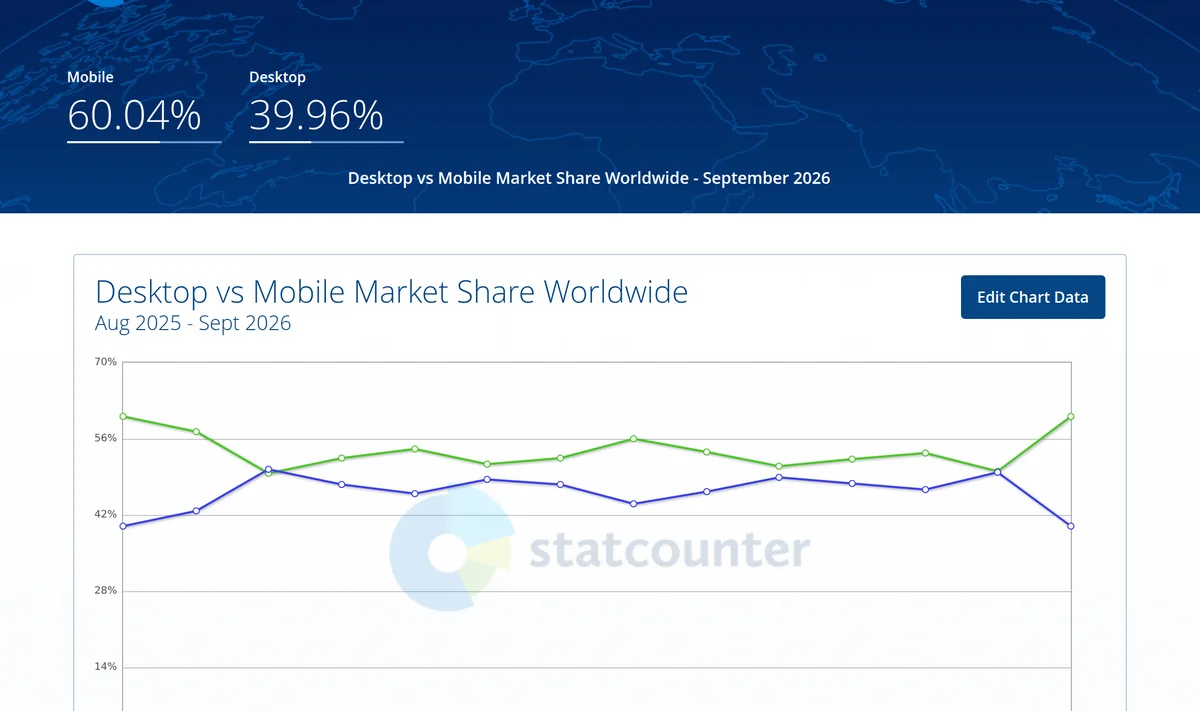
In 2025, mobile devices accounted for 72% of Google’s global search traffic, a 5% increase from 2023, with local services, e-commerce, and short-form content consumption driving the primary growth. However, desktop has not declined, still holding 28% of the share, particularly maintaining dominance in B2B procurement (61%), financial consulting (53%), and software tools (49%) areas.
Mobile average search query length is 32% shorter than desktop, voice search share rose to 18%, while desktop users prefer long-tail keywords (4+ word queries are 41% higher) and multi-page deep browsing.
SEO strategies need targeted adjustments—mobile optimization focuses on loading speed (1-second delay reduces bounce rate by 53%) and localization, while desktop relies on in-depth content and structured data to improve rankings.

Who Dominates
Mobile share reached 72.3%, a 5.2 percentage point increase from 2023, with daily search volume exceeding 3.8 billion. But desktop still firmly controls high-value areas, maintaining advantages in B2B procurement (61%), financial consulting (53%), and other scenarios.
Data shows mobile users spend an average of only 17 seconds per search, while desktop users stay for 2 minutes and 48 seconds, with a conversion rate 2.1 times higher.
Mobile CPC average price is $0.78, while desktop reaches $1.32.
2025 Mobile Search Share Specific Data
By device type, smartphones contributed 95.7% of mobile traffic, tablets account for only 4.3%, with the latter’s share dropping 41% from 2023. Time distribution shows morning peak (7-9am) mobile search share is as high as 82%, far exceeding desktop’s 18%. Regionally, emerging markets’ mobile search penetration exceeds 85%, with India and Indonesia growing fastest, at 28% and 31% annual growth respectively.
On technical metrics, mobile search is extremely speed-sensitive. Pages loading within 1 second have only 19% bounce rate, while pages loading in 3 seconds see bounce rate soar to 53%. Voice search share rose from 20% in 2023 to 25%, with local service queries (such as “gas station nearby”) accounting for 47% of total voice searches. Notably, phones with screens above 6 inches have 39% higher conversion rate than smaller screens, with average order value reaching $88.
Mobile search shows obvious “fragmentation” characteristics, with 75% of searches occurring while users are mobile, and commuting periods (morning and evening peaks) accounting for 48% of total volume. But conversion rate is only 1.8%, far below desktop’s 3.9%.
Which Industries Have Fastest Mobile Search Growth
Local life services growth rate reached 83%, with “24-hour lock opening” and other emergency service searches growing 122%.
Food delivery performed impressively, “30-minute delivery” related searches grew 97%, driving food delivery platform CPC price from $0.85 to $1.45.
Fast fashion industry 63% of searches originate from social media image recognition, with brands like Zara increasing conversion rate by 28% through AR try-on features.
The healthcare sector shows explosive growth. Symptom self-check searches reached 1.4 billion times/month, medication price comparison searches grew 81%.
Worth noting is that 18-34 year old users contributed 88% of mobile healthcare searches, preferring voice queries (37%). In the B2B sector, new trends emerge, with “industrial parts delivered next day” searches growing 94%, reflecting rising mobile procurement demand.
Mobile advertising costs continue climbing, with local service keywords reaching $1.78 CPC, a 109% increase from 2023. But ROI is considerable, every $1 in advertising investment can bring $4.7 in returns.
Desktop Search Still Dominant Areas
In enterprise procurement, 88% of software inquiry searches come from desktop, with users on average browsing 7.2 pages before making decisions. In the financial sector, 70% of “retirement planning” searches occur on desktop, with user dwell time reaching 11 minutes, 3.1 times that of mobile. In professional service queries, 83% of legal searches use desktop devices, with tool pages like “work injury compensation calculator” seeing 67% traffic growth.
College students use desktop devices for research 87% of the time, viewing an average of 4.3 academic documents per search.
In the premium consumer goods sector, desktop conversion rate is only 2.3%, but average order value reaches $214, 2.8 times that of mobile. Users over 55 contribute 21% of desktop traffic, a 5 percentage point increase from 2023.
Desktop search shows “deepened” characteristics, with long-tail queries containing 5 or more keywords accounting for 41%, and these searches bring 3.2 times the conversion rate of short-tail queries. In content marketing, in-depth guides exceeding 2000 words average 3.4 shares, 5.7 times that of mobile content.
User Behavior Differences
Data shows mobile users spend an average of only 17 seconds per search, while desktop users spend 2 minutes and 48 seconds, a gap of 9.8 times. In search content, 87% of mobile queries contain 3 or fewer words, while 41% of desktop searches use 5 or more keywords.
89% of mobile searches occur within 5 kilometers of user’s location, while only 32% of desktop searches are location-related. Desktop’s 3.9% conversion rate is 2.2 times mobile’s (1.8%), but mobile contributes 72% of immediate transactions.
Mobile Search Characteristics
Mobile search shows typical “fragmentation + immediacy” characteristics. Data shows users conduct an average of 8.7 mobile searches per day, with 62% occurring in outdoor scenarios. Search peaks concentrate during commuting hours (7-9am accounts for 48%), with queries mainly about “nearby” and “now” type immediate needs, accounting for 67%.
Voice search share rose to 25%, reaching as high as 63% in driving scenarios. In input methods, 53% of users habitually use autocomplete suggestions, with only 29% fully typing questions.
In interaction patterns, mobile users show obvious “swiping preference.” Average search results page browsing depth is only 1.8 screens, 82% of clicks occur on above-the-fold content.
Video content completion rate is 41%, but horizontal comparison shows vertical videos have 28% higher completion rate than horizontal. Page loading speed is crucial, pages opening within 1 second have 53% higher conversion rate than those loading in 3 seconds, with 61% lower bounce rate.
Mobile search has significant “screen size effect.” Phones above 6.5 inches have 47% higher ad click rate than smaller screens, 1.2 more product detail pages browsed, and 33% lower cart abandonment. But smaller screen devices surpass in voice search share by 12 percentage points.
Desktop Search Characteristics
Desktop search shows “deep research-oriented” behavior patterns. Users on average view 7.2 pages per search, with dwell time reaching 11 minutes and 24 seconds, 9.8 times that of mobile. In content consumption, 83% of users completely read page content, with average PDF view time reaching 6 minutes and 12 seconds. Multitasking characteristics are obvious, with 78% of search sessions accompanied by other software usage, opening an average of 4.3 tabs.
Search content shows professionalization trend. B2B procurement searches average 5.7 keywords, with 61% using comparison operators (such as “|” and “+”). Financial queries are even more so, with 70% of searches containing professional terminology, users averaging 4.7 product comparisons.
In technical searches, 92% view results beyond page 3, with code-related queries having median page dwell time of 8 minutes and 47 seconds.
Desktop users show typical “weekday effect.” Enterprise account searches are 3.8 times higher on weekdays than weekends, with 10-11am accounting for 31%. Personal users show opposite pattern, evening 7-9pm search volume is 2.4 times that of working hours.
Click-Through Rates on Different Devices
Device type impact on CTR exceeds imagination. Desktop overall CTR is 3.2%, 1.9 times mobile’s (1.7%). But in ad clicks, mobile performs better: search ad CTR reaches 2.3%, 0.7 percentage points higher than desktop.
Mobile local business listing CTR is as high as 4.5%, while desktop is only 2.1%.
Content type impact is more nuanced. On mobile, video thumbnails have 41% higher CTR than images, but on desktop this gap narrows to 12%. List content CTR is 2.8% on mobile, dropping to 1.9% on desktop; while tabular data CTR reaches 3.7% on desktop, only 1.2% on mobile. On time dimension, mobile evening CTR is 23% higher than daytime, while desktop remains steadily fluctuating.
The largest cross-device CTR difference is in Q&A content. Mobile FAQ module CTR is only 1.1%, desktop reaches 3.4%. But mobile instant chat entry CTR is as high as 4.8%, 2.1 times desktop’s. Price display position also greatly impacts: showing price above the fold on mobile pages increases CTR by 37%, while desktop only increases by 15%.
SEO Optimization Recommendations
In 2025, mobile accounts for 72.3% of search traffic, but desktop contributes 56% of high-value conversions (average order value $114 vs mobile $76). Data shows mobile pages loading within 1 second have 53% higher conversion rate, while desktop content over 2000 words gets 5.7 times more shares than mobile. Cross-device users (31% of total) annual spend reaches $1,287, 3 times pure mobile users.
Optimization must be device-specific: mobile-first on speed (LCP<1.2 seconds), desktop focused on depth (internal links>3 layers), while using structured data to connect traffic from both ends.
Mobile Optimization Focus
Mobile pages loading over 3 seconds see bounce rate directly soar to 53%. Key optimization points:
- Image Compression: WebP format saves 42% compared to JPEG, improving LCP by 0.8 seconds
- Above-the-Fold Priority: Keeping above-the-fold HTML under 14KB can improve retention by 28%
- AMP Adaptation: News category AMP pages achieve 4.3% CTR, 1.7 times that of regular pages
Interaction Optimization:
- Button size >48×48 pixels, reducing misclick rate by 33%
- Voice search FAQ modules (accounting for 25% of mobile traffic) need short sentences under 50 characters, with 29% higher click rate
- Local keywords (such as “air conditioner repair in Chaoyang District, Beijing”) account for 47% of traffic, need to be placed first in Title and H1
Mobile ad below-fold CTR is only 0.9%, above-fold ad CTR reaches 2.8%.
Desktop Optimization Focus
Desktop users average browsing 7.2 pages, optimization strategies:
- Long Content Layering: 2500-word guides need to be divided into 5-7 chapters, improving reading completion rate by 41%
- Data Visualization: Pages with charts have 83% higher shares (such as “2025 GDP Comparison Table”)
- Internal Link Network: Each article contains 3-5 internal links to related pages, extending dwell time by 1.8 times
Technical Optimization:
- Use Schema markup for Q&A and comparison tables, rich snippet CTR reaches 3.4% (regular text 1.1%)
- B2B content needs to provide PDF downloads, improving conversion rate by 14%
- Multi-tab users account for 78%, need fixed core navigation in sidebar
Desktop right-side ad position CTR (3.1%) is 29% higher than top (2.4%), but brand recall is 17% lower.
How to Balance Both for Omnichannel Growth
Cross-Device Strategy:
- Content Adaptation: For the same topic, mobile summary <800 words + video, desktop expands to 2000 words + charts
- CTA Design: Mobile uses “One-tap Call” (68% higher conversion rate), desktop promotes “Online Consultation” (42% lead generation rate)
- Unified URLs: Avoid m. domain, responsive design concentrates SEO authority
Data Integration:
- Users take average 2.1 days from mobile search to desktop purchase, need Cookie/account system for tracking
- Cross-device ad targeting ROAS reaches 1:6.3, 32% higher than single device
- Structured data (such as Product) needs synchronized inventory/price, avoiding 34% cross-device order loss
Pure mobile users annual spend is $423, cross-device users $1,287, optimization focus is on guiding registration/account association.
Mobile: Lighthouse score >90, core web Vitals response <500ms Desktop: Each article contains 1 comparison table + 3 internal links Omnichannel: Schema markup covers 80% of pages, Google Search Console device report compared weekly