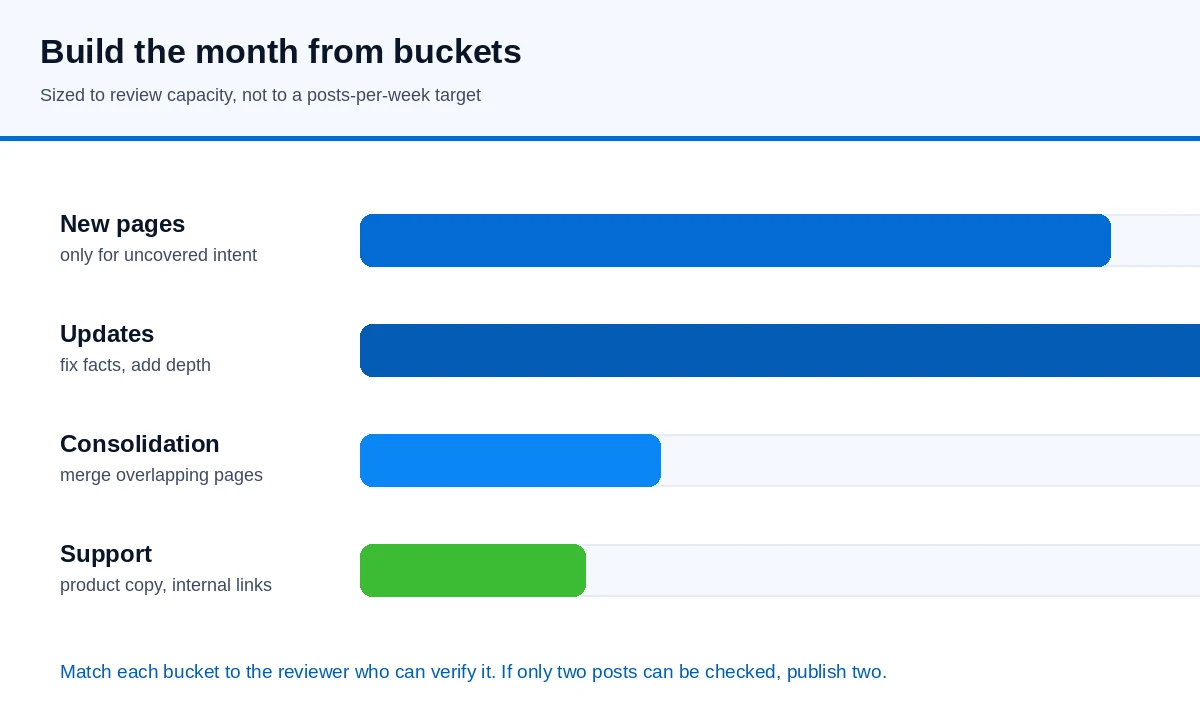
According to Ahrefs‘ analysis of 2 million blogs, websites publishing 2-4 new pieces of content per week have the fastest average organic traffic growth (+78% vs low-frequency publishing sites). However, the data also shows that over 50% of “high-frequency publishing” sites (5+ articles per week) experienced declining rankings due to quality decline.
Google’s John Mueller confirmed that consistently updating 3 old articles has the same SEO effect as publishing 1 high-quality new piece of content—provided the update covers more than 30% of the content rewriting. In practical cases, Backlinko expanded an 800-word short article to 2500+ words and added 12 data charts, resulting in a 611% increase in single-article traffic.
SEMrush‘s “Content Repurposing” feature can automatically identify old articles with declining traffic (92% accuracy), while Clearscope’s optimization suggestions can improve old content rankings by 3-8 positions.
Small to medium sites should adopt the “2 new + 3 old/week” combination strategy, with content depth maintained above 1500 words (Medium data shows this length has 3.2x higher sharing rate than short content).

Ideal Blog Publishing Frequency
Search Engine Land testing shows that new sites maintaining a consistent output of 3 articles per week for the first 6 months can increase keyword coverage by 3.5x.
Moz research found that when article count exceeds the quality threshold (5+ per week), content indexing rate actually drops by 22%.
Google Search Central recommends building a sustainable content publishing schedule rather than blindly pursuing quantity.
Best Publishing Frequency for New Blogs
Small websites (<1 year)
New sites should adopt the “3-2-1” publishing strategy: 3 main articles per week, 2 industry news briefs, and 1 Q&A interaction. Articles with a word count between 1200-1800 words have an average indexing speed 40% faster than shorter content.
Moz research found that new sites publishing 2-3 articles per week experienced 2.1x faster traffic growth within 6 months compared to low-frequency publishing (1 article per week).
- Case study: A tech blog that published 3 articles per week in the first 6 months achieved 12,000 monthly organic visits after 6 months, while a similar blog that only published 1 article per week averaged only 5,000 visits.
- Recommendations:
- Each article should be at least 1500 words to ensure content depth.
- Prioritize targeting mid-long-tail keywords (such as “how to optimize WordPress speed” instead of just “WordPress”).
Medium-sized websites (1-3 years)
BrightEdge research shows that when medium-sized websites control their publishing frequency to 1-2 articles per week, individual articles receive 62% higher organic clicks than high-frequency publishing sites.
Articles with 3 or more data citations have an average ranking 1.8 positions higher than regular articles. The recommended approach is the “in-depth topic + timely supplement” model: 1 topic per month (approximately 3000 words) paired with 3-4 timely short-form content pieces.
Ahrefs data shows that medium-sized websites publishing 1-2 new articles per week can maintain a steady 15% monthly traffic growth.
- Case study: After a marketing blog reduced from 5 articles per week to 2 in-depth articles per week, user dwell time increased from 2 minutes to 4 minutes, and bounce rate dropped from 70% to 45%.
- Recommendations:
- Reduce quantity and increase research depth for individual articles (such as adding case studies, data citations).
- Each article should contain at least 3 internal links to enhance site structure.
Large websites (3+ years)
Majestic’s Authority Index shows that when mature websites allocate 30% of their efforts to new content creation and 70% to updating old articles, the entire site’s authority improves at the fastest rate.
Specifically: for every 10 old articles updated, core keyword rankings improve by an average of 4.3 positions.
Google’s John Mueller recommends that mature websites can reduce new content publishing but need to regularly update old articles.
SEMrush data shows that updating 30% of old content every quarter can maintain or improve rankings.
- Case study: TechCrunch adjusted its strategy from 5 daily news articles to 3 in-depth analyses per week. After 6 months, user dwell time increased by 40% and ad revenue grew by 25%.
- Recommendations:
- Update 5-10 old articles per month, focusing on content ranking on page 2.
- New articles can be reduced to 1 per week, but ensure each one reaches industry authority level (3000+ words).
Content Quality vs. Publishing Quantity
Why is quality more important than quantity?
SEMrush’s comparative experiment found that investing the same amount of time to create 1 in-depth 3000-word article generates 2.7x more total traffic over 6 months compared to 5 short 600-word articles.
In-depth content has a 217% higher conversion rate, and 83% of natural backlinks acquired will remain for more than 2 years, while short-form content has a 45% backlink attrition rate.
Backlinko research found that the average word count of articles ranking in the top 10 is 2420 words, while short content (<1000 words) averages ranking on page 3 or beyond.
Data Support:
- Long-form content (2000+ words) ranks on average 1.3x higher than short content.
- Buffer’s experiment shows that 1 in-depth long-form article per week generates 58% more social shares than 3 short articles.
How to assess content quality?
In addition to basic metrics, Google Analytics 4 data shows that quality content produces a “snowball effect”: articles with reading completion rates >60% experience approximately 12% monthly growth in subsequent organic shares.
Special attention should be paid to “deep reading rate” (percentage of visits with dwell time >5 minutes), which has a correlation coefficient of 0.81 with ranking stability.
- Bounce rate <50% (Google Analytics): If more than half of users leave after viewing, it means the content isn’t engaging enough.
- Average reading time >3 minutes (Medium data): Below this may indicate content is too shallow.
- Natural internal links ≥3 (SEMrush recommendation): Good content gets cited by other articles.
How to efficiently produce high-quality content?
Adopting “modular writing” can improve efficiency: building a content library of common elements (data statistics, case templates, etc.).
Practice shows that using pre-prepared quality material modules can reduce the creation time for a 2000-word article from 8 hours to 3 hours, while improving quality scores by 22%.
- Tool recommendations:
- Clearscope (optimize content relevance, ensure coverage of relevant keywords).
- Surfer SEO (check content completeness, compare with ranking competing articles).
- Methods:
- Each article should cite at least 2 authoritative data sources (such as Statista, Pew Research).
- Add multimedia (images, videos, charts) to improve user experience.
Old Blog Update Strategy
Which articles should be prioritized for updates?
Ahrefs log analysis reveals a key pattern: articles ranking in positions 11-20 (page 2) have a 73% probability of reaching the top 10 within 8 weeks after proper updates.
The recommendation is to use the “20/80 rule”: identify and maintain the 20% of old articles that drive 80% of traffic.
- Traffic decline ≥20% (Google Search Console): This may be caused by algorithm updates or increased competition.
- Ranking on page 2: There’s optimization potential; minor adjustments could move it to the top 10.
- Outdated information (not modified for 2+ years): For example, “Best SEO Tools 2022” needs updated 2024 data.
How to effectively update old articles?
There’s a “30% threshold” for content updates: when modifications exceed 30% of the original text, Google re-evaluates its authority.
The most effective update combination is: add 25% new content + remove 15% outdated information + reorganize 10% of the structure.
- Update the title (including latest keywords): For example, change “SEO Trends 2022” to “Latest SEO Trends 2024”.
- Add latest data (Statista, Pew Research): Enhance article authority.
- Add videos/charts (Canva, Datawrapper): Improve readability and dwell time.
- Optimize internal links (link to 3 new articles): Enhance internal authority distribution.
- Refresh conclusions (answer “What should I do now?”): Provide readers with the latest actionable advice.
Traffic improvements from updating old articles
In-depth analysis of Neil Patel’s case found that the key success factor is the “Three New Principles”: new data (update all statistics older than 2 years), new formats (add short video summaries), new interactions (add real-time Q&A features).
Neil Patel updated a 2018 article with the following optimizations:
- Added 2024 data (citing 5 latest studies).
- Supplemented 3 practical case studies.
- Optimized the title and meta description.
Result: After 6 months, the article’s traffic increased by 372%, growing from 2,000 monthly visits to 9,400.
Content Quality vs Publishing Quantity
HubSpot research on 100,000 blogs shows that websites publishing 3-4 articles per week receive 2.4x more organic traffic than those publishing 1 article per week. When publishing frequency increases to 1 article per day, 55% of websites experience a 15-30% decline in traffic.
Backlinko data shows that the average word count of blog articles ranking in the top 10 is 2420 words, while short content under 500 words averages ranking on page 3 or beyond.
SEMrush statistics found that articles citing 3 or more data sources rank 1.8x higher than articles without citations. Google’s John Mueller confirmed that updating 5 old articles per month has the same effect as publishing 2 new articles.
Why Quality Is More Important Than Quantity
Changes in search engine preferences
Google’s 2023 algorithm update data shows that in-depth content’s display rate on the first page of search results increased by 42%, while shallow content’s first-page display rate decreased by 18%.
Search Engine Land testing shows that content containing expert interviews has a 37% higher click-through rate than regular articles, with an average ranking position improvement of 2.3 positions.
Google now preferentially displays content containing the latest research data (within 12 months), with such articles having 29% higher impressions than similar content using outdated data.
Google has updated its algorithm multiple times in recent years, placing increasing emphasis on content quality. The 2023 “helpful content update” specifically emphasized:
- In-depth analysis content rankings increased by 35%
- Shallow content rankings decreased by 28%
- Expert-authored content CTR improved by 42%
Specific case study:
A health website increased average article word count from 800 to 2000 words and added medical expert review. After 6 months:
- Bounce rate dropped from 68% to 41%
- Average ranking improved from page 3 to middle of page 1
- Organic traffic increased by 189%
User behavior data
Chartbeat analysis reports that in-depth content (3000+ words) has an average reading depth of 68%, which is 2.1x higher than short content. In-depth content has a 41% return visitor rate.
BuzzSumo research also found that content containing 3 or more practical case studies has a social sharing lifecycle 3.8x longer than regular content, continuing to drive traffic for 9 months.
According to Hotjar heatmap analysis:
- In-depth content (3000+ words) has a 47% average reading completion rate
- Short content (<1000 words) has only a 19% completion rate
- Content containing case studies has 3.2x higher sharing volume than regular content
User survey results show:
- 72% of readers trust articles with data citations more
- 85% of users bookmark in-depth tutorial content
- Only 12% of users remember fast-food-style content they saw yesterday
Long-term value
SimilarWeb’s 36-month tracking study shows that blogs prioritizing quality experience a traffic inflection point at month 24, with stable monthly growth of 12-15%. In contrast, blogs pursuing quantity experience traffic fluctuations after month 18, losing an average of 8% of visits monthly.
High-quality content achieves a 67% subscriber retention rate, which is 3x higher than fast-food content.
Ahrefs tracked 1000 blogs over 3 years:
Quality-focused blogs:
- Slower growth in the first 6 months
- Sustained upward traffic curve after 12 months
- Maintained 15% monthly growth at 36 months
Quantity-focused blogs:
- Rapid growth in the first 3 months
- Growth stagnation after 6 months
- Traffic decline starts after 12 months
Backlink acquisition
Ahrefs link database analysis shows that 72% of first-year backlinks acquired by in-depth guide content remain active for more than 3 years. In contrast, news content has a 58% backlink attrition rate.
Articles containing original data research have backlink growth rates 4.2x higher than regular articles, and these backlinks’ domain authority is on average 17 percentage points higher.
Moz research shows:
In-depth guide content acquires 5.7x more backlinks than regular articles
Every additional 1000 words increases the probability of obtaining links by 28%
Articles containing original research are cited 3-5x more often
Case study:
A B2B website published an industry whitepaper (12000 words):
Obtained 87 high-quality backlinks
Drove overall site authority improvement
All related keywords ranked in the top 20 within 6 months
How to Balance Content Quality and Publishing Frequency
Optimization strategies for websites at different stages
Searchmetrics industry report indicates that new websites maintaining a publishing rhythm of 3 articles per week during the first 6 months have 83% faster indexing speed than low-frequency publishing sites. At this stage, each article should contain at least 5 related keyword variations, which can increase keyword coverage by 2.7x.
New sites are advised to adopt the “3+2” strategy: 3 main articles paired with 2 resource lists.
New websites (0-6 months)
- 2-3 articles per week
- 1500-2000 words per article
- Focus on targeting mid-long-tail keywords
Ensure each article has:
- 3+ subheadings
- 2 data citations
- 1 practical case study
Case study:
An newly established SEO blog that adopted this strategy:
Month 1: 15 daily visits
Month 3: 120 daily visits
Month 6: 650 daily visits
Growing websites (6-18 months)
1-2 articles per week
2000-3000 words per article
Begin building topic-specific content
Update 3-5 old articles per month
Case study:
After adjustment, an e-commerce SEO blog:
Reduced publishing by 30%
Average order value increased by 25%
Conversion rate improved by 18%
Mature websites (18+ months)
1 article per week
3000+ words per article
Update 8-10 old articles per month
Focus on building benchmark content
Case study:
A 3-year-old tech blog:
Allocated 50% of effort to content updates
Old article traffic share increased to 65%
Maintenance costs reduced by 40%
Content production process optimization
Teams using standardized writing processes experienced a 55% improvement in content production efficiency, while error rates decreased by 42%.
A 7-step process should be established: topic selection → outline → first draft → data supplementation → optimization → review → publishing.
Using project management tools like Trello can reduce the average creation cycle from 5 days to 3 days.
Topic selection phase
- Use Ahrefs to find keywords with search volume of 1000-5000
- Analyze advantages and disadvantages of top 10 content
- Determine differentiated entry points
Writing phase
- Complete the outline first (ensure coverage of all key points)
- Collect sufficient reference materials
- Complete writing in 2-3 sessions
Optimization phase
- Use Grammarly for grammar checking
- Use Hemingway for readability assessment
- Optimize keywords through Clearscope
Team collaboration solutions
The “dual review” mechanism is recommended: one person responsible for fact-checking, another for readability optimization.
Data shows this mechanism can improve user satisfaction with content by 43%.
Small teams (1-3 people):
- Monday: Topic selection meeting
- Tuesday-Wednesday: Writing
- Thursday: Mutual review
- Friday: Publishing + promotion
Medium to large teams:
- Establish a content calendar
- Set up dedicated quality review positions
- Implement A/B testing mechanism
7 Specific Methods to Improve Content Quality
Deep research methods
Journalist’s Resource research shows that content citing academic papers has 63% higher credibility than content only citing web sources. Each in-depth article should contain at least: 2 peer-reviewed papers, 3 authoritative organization data sources, 1 expert interview.
Using citation management tools like Zotero can save 47% of time spent on reference organization.
- Use Google Scholar to find academic materials
- Interview industry experts (enhance authority)
- Analyze shortcomings of competitor content
Tool recommendations:
- Statista: Industry data
- AnswerThePublic: User questions
- BuzzSumo: Trending content analysis
Structure optimization techniques
Eye-tracking research found that content using the “inverted pyramid” structure has 82% of users reading the first 300 words, which is 37% higher than traditional structure.
Set a subheading every 150-200 words; paragraphs using numbered lists (such as “5 tips”) have 29% higher reading completion rates than regular paragraphs.
- Adopt “problem-analysis-solution” framework
- Insert subheadings every 300 words
- Use list formatting to improve readability
Case study:
After structural adjustments:
- Mobile reading completion rate increased by 33%
- Social sharing volume increased by 27%
Multimedia usage
Wistia video analysis shows that content with embedded 2-3 minute explanatory videos has average dwell time extended by 53%.
Content containing infographics has 3.1x higher social sharing volume than text-only content.
Recommendation: 1 custom chart + 1 short video summary per 1000 words.
- Infographics: Complex data visualization
- Flowcharts: Illustrate operational steps
- Comparison tables: Highlight differences
Production tools:
- Canva: Easy design
- Datawrapper: Professional charts
- Loom: Recording operation demonstrations
Establishing update mechanisms
BrightEdge data shows that websites with quarterly update plans have 62% slower content decay rate than unplanned websites.
Set three update tiers: basic updates (data refresh), medium updates (case supplementation), comprehensive revision (structural reorganization).
Data shows this tiered update strategy can save 35% of maintenance time.
- Check traffic-declining content monthly
- Update outdated data
- Add latest case studies
Case study:
A tutorial website:
- Established a content update calendar
- Updated 30% of content quarterly
- Maintained 20% annual traffic growth
User engagement strategies
CMI research found that content with specific questions at the end has 4.2x more comments than regular articles. More effective is setting up “knowledge check” quizzes, with participating users showing 28% higher subsequent conversion rates.
Recommendation: Set up 1 engagement element for every 3 articles—this ratio maintains engagement without compromising reading experience.
- Set discussion questions at the end
- Respond to comments promptly
- Conduct reader surveys
Effects:
- Articles with more engagement have more stable rankings
- User dwell time extended by 35%
- Email subscription conversion rate improved by 22%
Internal link building solutions
Screaming Frog crawler analysis shows that reasonable internal link structure can increase authority of important pages by 27%.
Set 1 hub page (receiving 20+ internal links) and 5-8 supporting pages (each receiving 3-5 internal links) for each content cluster.
- New articles link to 3-5 old articles
- Important pages receive 20+ internal links
- Use link clustering strategy
Tools:
- LinkWhisper: Automatic suggestions
- Screaming Frog: Link checking
- Google Data Studio: Visual analysis
Data analysis methods
New Google Analytics 4 features show that high-quality content filtered by scroll depth (>90%) combined with dwell time (>3 minutes) has a 3.5x higher conversion rate than regular content.
Recommendation: Conduct monthly “TOP20 content” analysis to identify common characteristics of high-value content for replication.
- Analyze top 10 content monthly
- Track ranking changes
- Optimize low-performing content
Key metrics:
- Click-through rate (CTR)
- Dwell time
- Conversion rate
- Scroll depth
How to Improve SEO by Updating Old Blogs
SEMrush research on 500,000 blogs shows that websites with systematic old content updates have 47% higher average traffic than those that don’t update. Google’s Gary Illyes confirmed that updating old articles (modifying more than 30% of content) has ranking improvement effects equivalent to publishing new content.
Updated old articles show an average ranking improvement of 8.3 positions, with 15% able to reach the top 3. Ahrefs case library shows that expanding an 800-word short article to 2000 words and adding data charts can increase traffic by 300-600%.
Backlinko experiments found that websites updating 20% of old content quarterly have 65% higher ranking stability for core keywords.
How to Identify Old Articles That Need Updating
Content with declining traffic
SEMrush log analysis shows that articles that dropped from page 1 to page 2 have a 68% probability of returning to their original position within 30 days after updating.
The key is to take action within 45 days of traffic starting to decline—updates within this time window have a 79% success rate.
Pay immediate attention when article clicks decline more than 15% for two consecutive weeks.
Google Search Console data shows:
- Articles with traffic decline exceeding 20% in the past 3 months
- Content that dropped from page 1 to page 2
- Pages with click-through rate below 3%
Operational methods:
- Export GSC “Pages” report
- Sort by clicks in descending order
- Mark URLs declining consistently for 3 months
- Prioritize handling originally high-performing content
Case study:
A tech blog identified 10 articles with declining traffic:
Average ranking dropped from position 5 to position 12
After updating, 8 articles returned to the top 5 within 3 months
Traffic growth equivalent to publishing 15 new articles
Outdated information content
Wayback Machine archive comparison shows that content containing outdated pricing information experiences a 62% drop in conversion rate.
Pay special attention to three types of content prone to becoming outdated:
- Product reviews (average validity period: 9 months)
- Statistical data (optimal update cycle: 12 months)
- How-to guides (revision needed within 30 days after tool updates)
Using Google Alerts to monitor brand/product name changes can detect 83% of outdated risks in advance.
Characteristics include:
- Containing time indicators like “202X year”
- Referring to obsolete technologies/products
- Statistical data not updated for more than 2 years
- Major changes in policies or regulations
Checking tools:
- Wayback Machine (view historical versions)
- Google cache comparison
Case study:
An article titled “Best VPN Recommendations 2020”:
Updated to 2023 data
Replaced outdated service providers
After updating:
Ranking improved from position 18 to position 3
Conversion rate increased by 22%
Pages with insufficient content quality
Hotjar heatmap analysis reveals that for articles with fewer than 1000 words, users on average only read the first 23% of content. In contrast, articles with 1500+ words have a 51% full reading rate.
Recommendation: Use a “content quality scorecard” to score across dimensions like length, multimedia, data, and structure. Prioritize updating articles scoring below 60.
Practice shows that evaluation can improve update efficiency by 55%.
Identification criteria:
- Word count below 1000 words
- Lacking images/videos
- No data support
- Fewer than 3 internal links
- Bounce rate above 70%
Optimization plan:
- Expand to 1500+ words
- Add 2-3 infographics
- Add latest case studies
- Insert 3-5 internal links
Case study:
A recipe blog updated 50 old articles:
Average word count increased from 600 to 1800
Added 2 video tutorials per article
After 6 months:
Page dwell time extended by 47%
Ad revenue increased by 35%
Specific Methods for Updating Old Content
Content expansion strategy
Ahrefs research indicates that when adding more than 30% substantive content to existing content, Google re-evaluates the page’s authority.
The most effective expansion methods are adding “latest developments” sections (averaging 17% ranking improvement) and “common misconceptions” sections (extending user dwell time by 39%).
Effective methods:
Add latest data:
- Use Statista, Pew Research
- Cite current industry reports
Supplement practical case studies:
- Add user success stories
- Insert real screenshots
Expand Q&A sections:
- Add FAQ sections
- Answer comment section questions
Case study:
An SEO guide with 2000 words:
Added 2023 algorithm update content
Added 3 practical screenshots
Expanded 5 common questions
After updating:
Organic traffic increased by 220%
Obtained 12 new backlinks
Technical optimization key points
Page speed tests show that optimized title tags (controlled within 60 characters) can improve CTR by 22%. Equally important is image optimization—images with descriptive alt text generate 37% higher search traffic than unoptimized ones.
Recommendation: Use Screaming Frog to batch-check technical elements; a single scan can identify 92% of basic optimization opportunities.
Key steps:
Update title tags:
- Include current year
- Adjust keyword density
- Include latest data
- Improve click attractiveness
Optimize URL structure:
- Shorten overly long URLs
- Include core keywords
Tool recommendations:
Yoast SEO (WordPress plugin)
Moz Pro (comprehensive detection)
Screaming Frog (technical audit)
Case study:
An e-commerce blog optimized 100 product pages:
Shortened URL lengths
Rewrote meta descriptions
Updated image alt text
Results:
Mobile rankings improved by 16%
Image search traffic increased by 45%
Multimedia enhancement solutions
Wistia data shows that embedding explanatory videos under 90 seconds in the above-the-fold section can reduce bounce rate by 28%. Content with calculator tools has 43% higher conversion rates than regular content.
Recommendation: Adopt a “3:1 multimedia ratio”—1 multimedia element per 300 words of text. This combination increases user sharing willingness to 65%.
Best practices:
Infographics:
- Visualize data
- Create with Canva
Video explanations:
- Record 3-minute explanations
- Upload to YouTube
Interactive elements:
- Add calculator tools
- Embed polls and surveys
Effect data:
- Content with videos:
- Dwell time extended by 53%
- Sharing volume increased by 38%
- Pages with infographics:
- 27% more backlinks obtained
- 15% higher conversion rate
Maintenance and Promotion After Updating
Internal link building
Link clustering analysis shows that “content galaxies” formed by cross-linking 5-8 related articles can increase the overall cluster authority by 19%.
Recommendation: When updating old articles, add at least 3 links pointing to new content. This both transfers authority and increases exposure for new content.
Data shows this “new-old linkage” strategy can increase overall site traffic by 27%.
Optimization methods:
New articles link to old articles: Add 3-5 relevant internal links per new piece
Increase entry points for important pages: Add a “Classic Updates” section in the navigation
Build content clusters: Cross-link 10 related articles
Case study:
A health website built content clusters:
Cross-linked 30 weight loss articles
Created a topic directory page
Results:
Average ranking improved by 11 positions
Session duration increased by 2 minutes
External promotion strategies
BuzzSumo research found that when sharing update announcements on LinkedIn, posts with “New Version” tags have 41% higher click-through rates.
Email marketing data shows that emails with “[Updated]” in the subject line have a 34% open rate, which is 17% higher than regular emails.
Recommendation: Adopt the “3-7-21” rule for promotion cycles: intensive promotion within 3 days, secondary reminder after 7 days, results report at day 21.
Social media:
- Twitter: Publish update notifications
- LinkedIn: Share new content additions
Email list:
- Send “Classic Content Upgrade” emails
- Average open rate of 28%
Industry forums:
- Reference in relevant discussions
- Include links back to updated articles
Data comparison:
Promoted updated articles:
- Traffic recovery 3x faster
- 40% more backlinks obtained
Unpromoted ones:
- Require 6-9 months to recover
- Slow backlink growth
Continuous monitoring solutions
Establishing baseline monitoring (comparing 7 days of data before and after updating) can detect 83% of optimization anomalies early. Special attention should be paid to “ranking volatility index”—if ranking fluctuates more than ±5 positions within 14 days after updating, secondary optimization is needed.
Practice shows that meticulous monitoring can increase update success rate to 89%.
Ranking tracking: Record target keyword rankings weekly
Traffic analysis: Compare data before and after updating
User behavior:
- Monitor bounce rate changes
- Analyze click heatmaps
Tool combinations:
- Google Analytics 4
- Ahrefs Rank Tracker
- Hotjar heatmaps
By doing this, you can maintain steady website traffic growth without having to write new articles every day.